
Rapid response through the simple and quick method diagnosis,
minimizing the economic loss of customers.
LIVESTOCK ANIMALS


RIDX®
BVDV Ag FE Test Kit
[LGM-BVG-11]
DESCRIPTION
Bovine viral diarrhea virus (BVDV) is a single-stranded RNA virus that causes significant economic losses around the world due to its impact on reproduction, respiratory health, and immunosuppression in cattle and other ruminants.
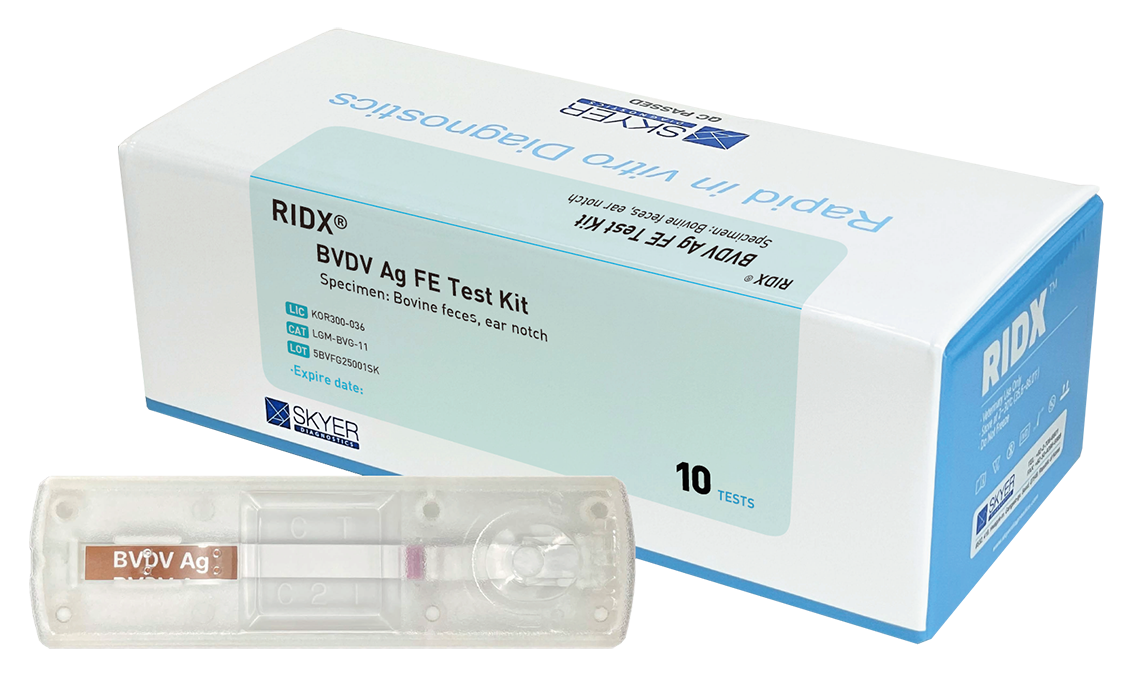
The RIDX® BVDV Ag FE Test Kit is a lateral flow chromatographic immunoassay for the qualitative detection of BVDV in bovine feces or ear notches. This kit shows two letters which are the test (T) line and the control (C) line on the surface of the device. If the BVDV antigen exists in the sample, it binds to the gold-conjugated anti-BVDV antibody. The antigen-antibody complex moves through the membrane by capillary force and responds to the secondary anti-BVDV antibody on the test line, resulting in a red line. The control line indicates that the test is performed correctly and should appear when the test is complete.
Two different monoclonal antibodies against the recombinant conservative nonstructural NS3 protein of BVDV are used as a capture and detector in the kit. The RIDX® BVDV Ag FE Test Kit can detect BVDV in bovine feces or ear notches with high accuracy.
SPECIMEN
Bovine feces or ear notch
COMPONENTS
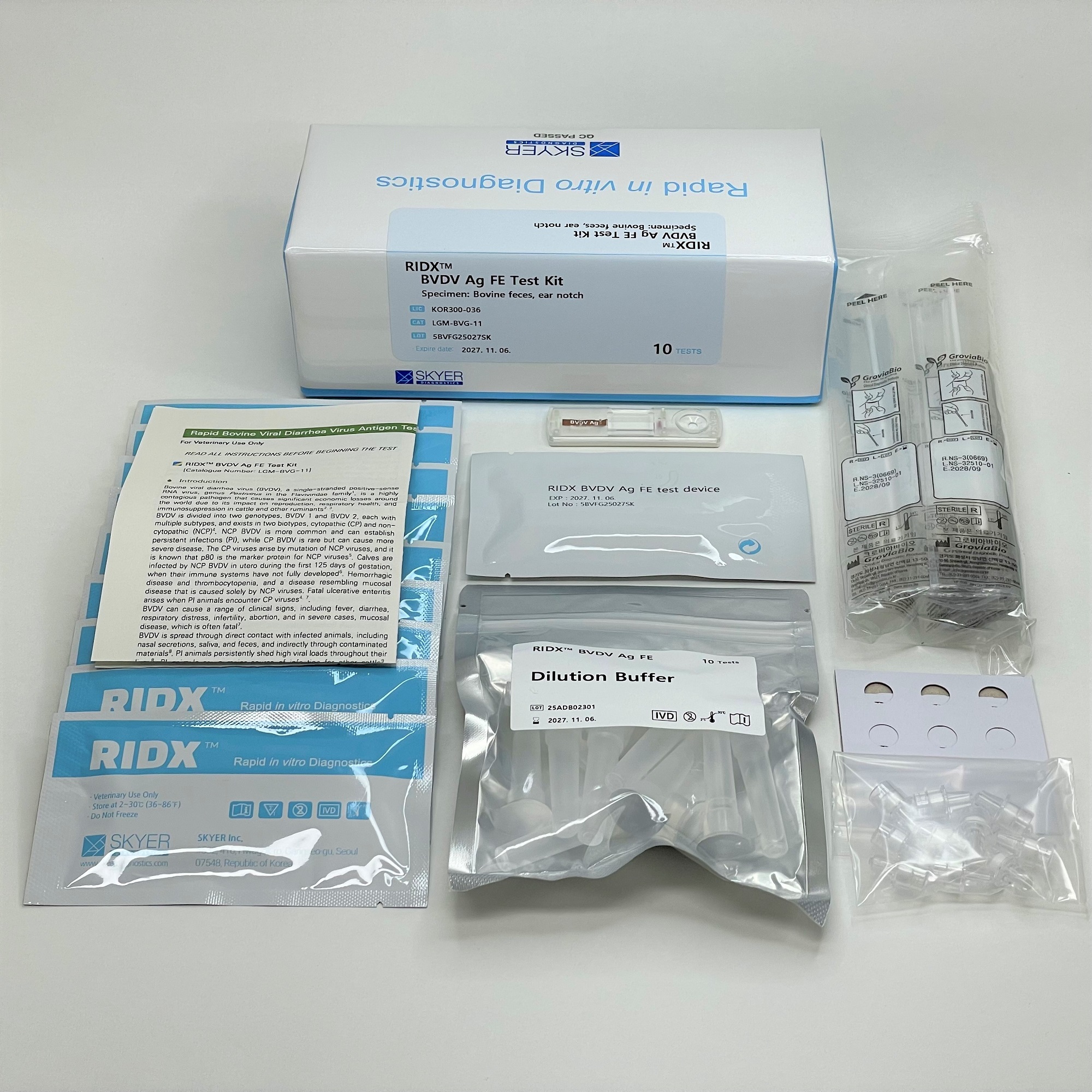
• RIDX BVDV Ag test device (10 tests)
• Sample dilution buffer (10 tubes)
• Disposable swab (10 ea)
• Dropper cap with filter (10 ea)
• Paper rack for standing buffer tubes (1 ea)
• Instructions for use (1 sheet)
FEATURES
• Sensitivity: Feces 90% (36/40) vs. RT-PCR, Ear notches 100% (14/14) vs. RT-PCR
• Specificity: Feces 100% (80/80) vs. RT-PCR, Ear notches 100% (71/71) vs. RT-PCR
• Diagnostic Agreement: Feces 96.67% (116/120) vs. RT-PCR, Ear notches 100% (85/85) vs. RT-PCR
• Limits of Detection: 1x10⁴ TCID50/mL
• No cross-reactivity with other bovine pathogens (Aino virus, Akabane virus, BCV, Rotavirus, CHUV and IBAV)
PACKAGE
• 10 Tests/Kit [LGM-BVG-11]
TEST PROCEDURE
[Fecal specimen]
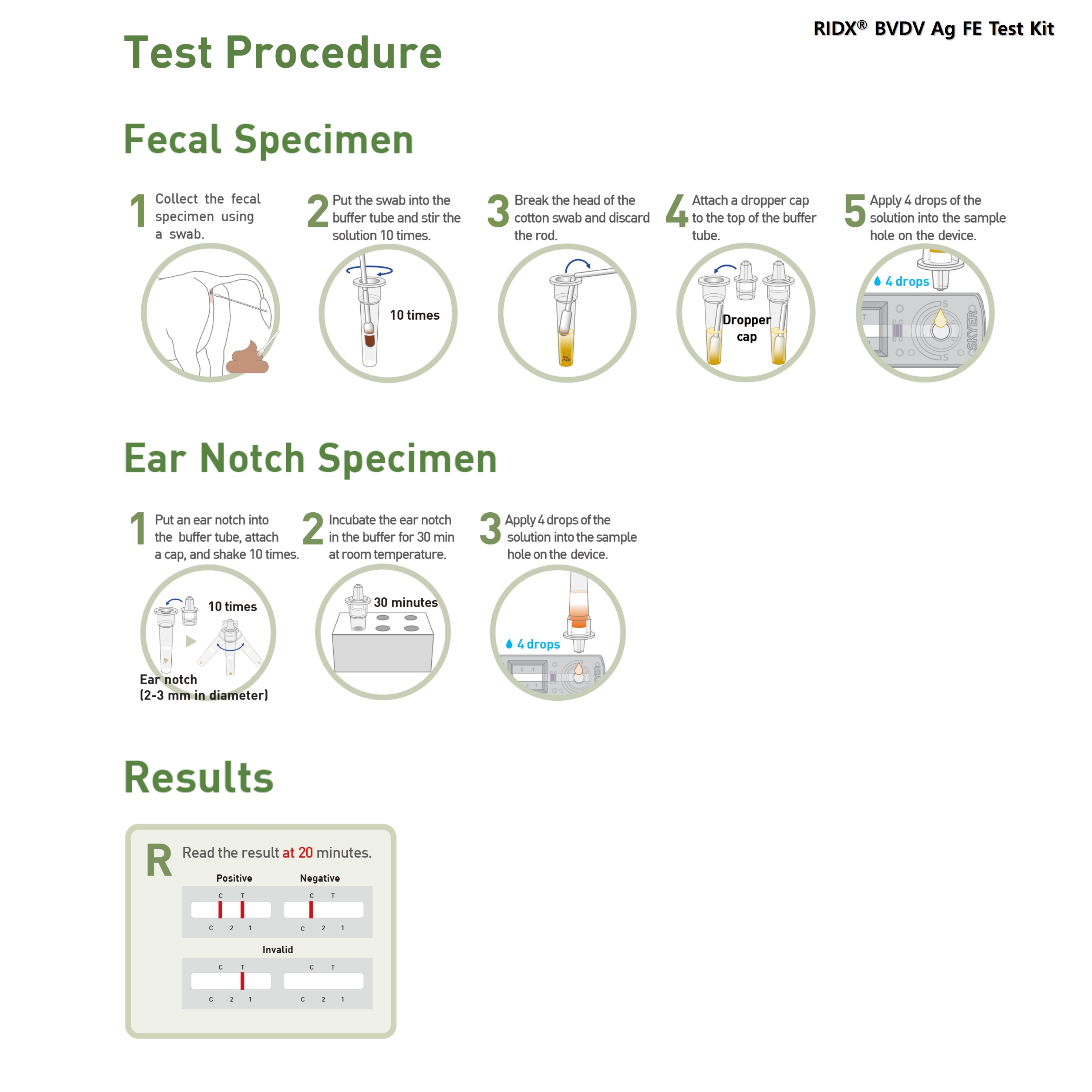
1. All samples and test components should be at room temperature (15~30°C/59~86℉) before use.
2. Using a swab to collect specimen.
3. Put the swab into the sample dilution buffer tube and stir the solution 10 times with the swab to disperse the specimen into the buffer.
4. Break the head of the cotton swab and discard the rod.
5. Attach a dropper cap to the top of the buffer tube.
6. Apply 4 drops (approximately 100 μL) of the processed solution in the sample hole on the device.
7. Read test result at 20 minutes.
[Ear notch specimen]
1. All samples and test components should be at room temperature (15~30°C/59~86℉) before use.
2. Collect an ear notch from cattle using an ear notcher.
3. Put the ear notch into the sample dilution buffer tube, attach a dropper cap to the top of the buffer tube, and shake 10 times.
4. Incubate the ear notch in the buffer for 30 minutes at room temperature (15~30°C/59~86℉). Do not leave it on for more than 30 minutes at this step.
5. Apply 4 drops (approximately 100 μL) of the processed solution in the sample hole on the device.
6. Read test result at 20 minutes.